
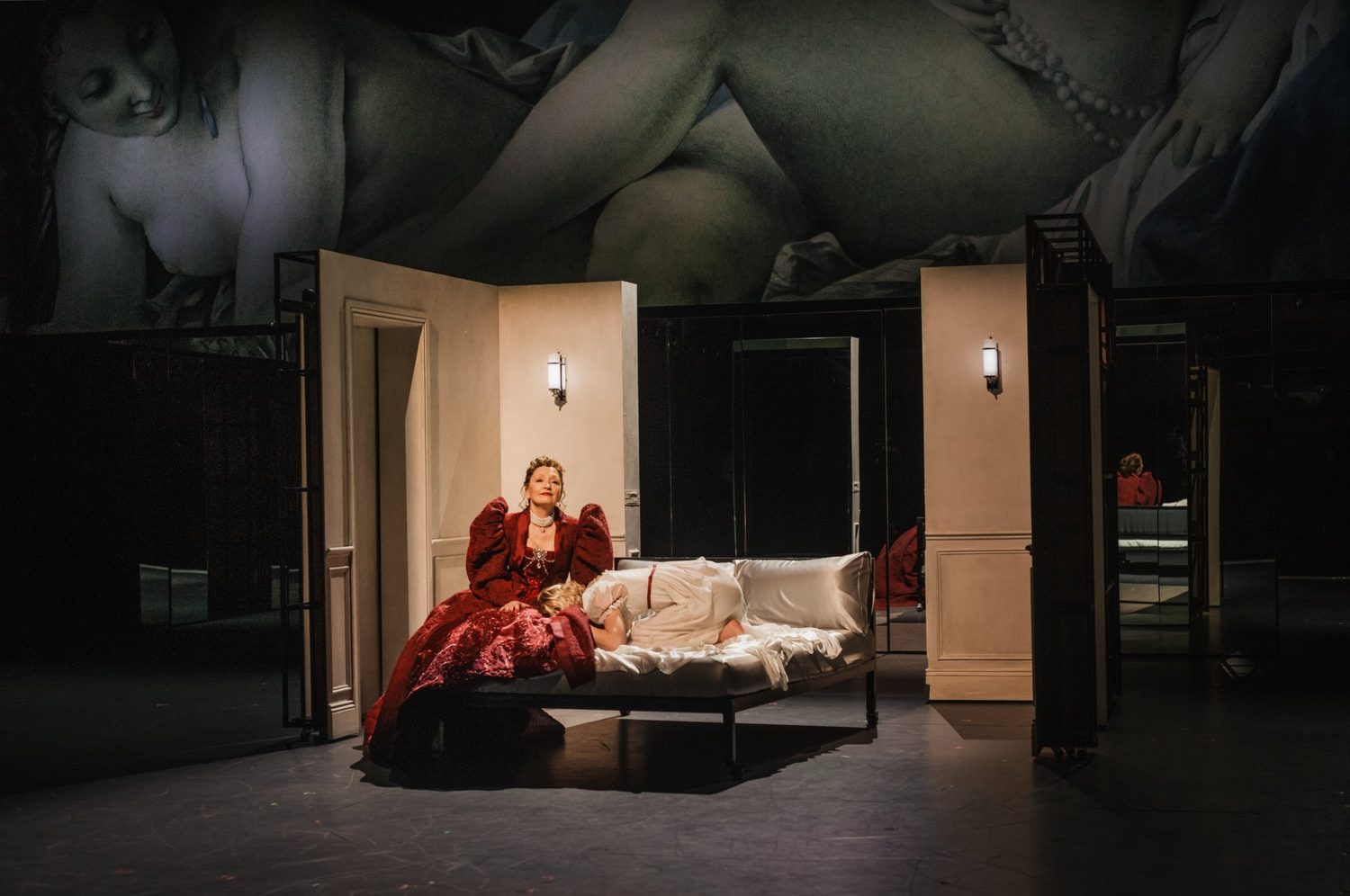
With a long performance history across the RSC, West End, Broadway, and film, Les Liaisons Dangereuses has often been defined by its sensuality and social intrigue. At its core, it is less a romance than a study in calculation – one driven by rivalry as much as desire. First published by Pierre Choderlos de Laclos, it is played out entirely through letters, each exchange carrying its own weight: delayed, curated, and carefully engineered. Seduction, in this form, is never spontaneous; it is written, refined, and deployed.
At the National Theatre, Marianne Elliott’s staging leans into that underlying structure, translating it into physical form. This is not a conventional revival. While many interpretations have cast Valmont as the play’s most visibly predatory and seductive force, this production introduces a noticeable shift in balance. Lesley Manville and Aidan Turner anchor the dynamic with contrasting modes of authority. Manville’s Marquise de Merteuil is defined by command, holding the centre of gravity as her authority subtly outweighs Valmont’s traditionally dominant position. Turner’s Valmont remains charmingly dangerous, this interpretation allowing for greater vulnerability than is often seen in other productions. Where his predatory instincts might traditionally dominate, here they are tempered, absorbed into the broader structural framework.
In Elliott’s Les Liaisons Dangereuses, seduction is no longer an impulse, but something refined, stylised, and carefully designed – a shift from seduction as language to seduction as system. This approach finds its foundation in Christopher Hampton’s 1985 adaptation, which frames the narrative through precision and strategy, transforming Laclos’ letters into verbal duels where wit and language become tools of manipulation. Elliott extends that logic beyond dialogue, creating a world in which power governs not only what is said, but how gestures and bodies interact and occupy space. Where screen adaptations have leaned into sensuality and emotional intensity, this production instead privileges structure over spontaneity.
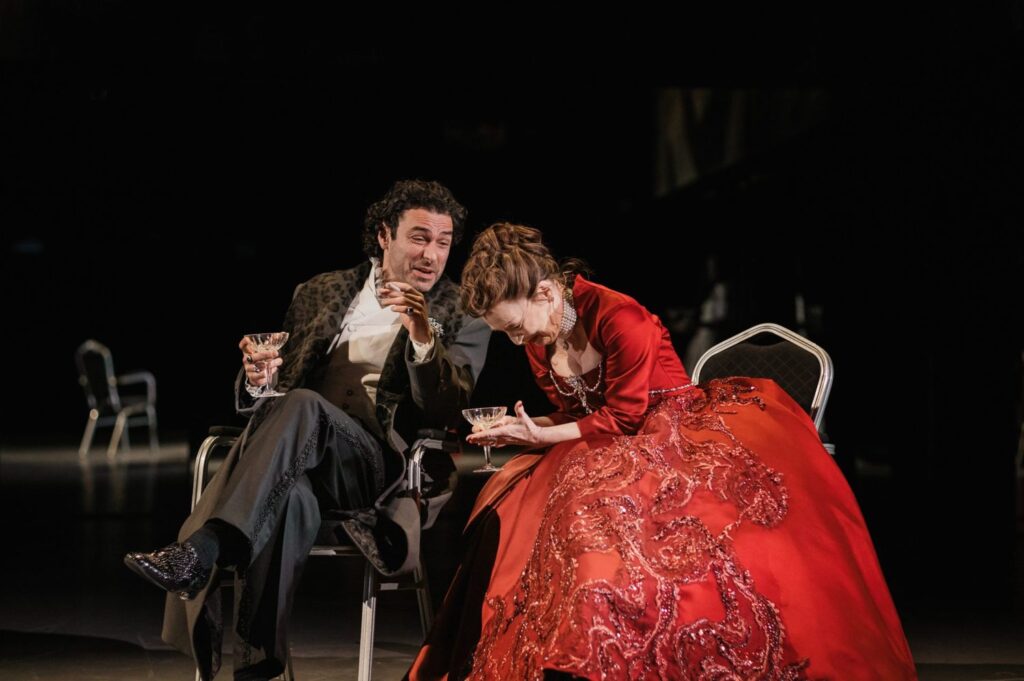
At the centre of the intrigue are Lesley Manville and Aidan Turner, whose performances anchor the production. Manville’s Merteuil is marked by precision and control. Every gesture, pause, and inflection feels calibrated, reinforcing her role not just as an orchestrator in the game, but as one of its architects. Her returns to Les Liaisons Dangereuses decades after appearing as Cécile in the original RSC production – a shift from ingénue to mastermind that mirrors the production’s evolution toward structure and composed design. Turner’s Valmont offers a contrasting presence. Where Manville’s authority is rooted in discipline, Turner operates through charm and fluidity. His performance carries an ease that at times softens the character’s cruelty, suggesting a different mode of control – one that is less rigid, but no less strategic. Together, they present two distinct approaches to power, creating a dynamic defined as much by contrast as by conflict. Beneath this balance, however, runs a clear current of competition. Their exchanges carry not simply strategy, but rivalry – a constant testing of limits in which attraction and opposition remain tightly intertwined. Moments of jealousy further sharpen this dynamic, briefly disrupting the production’s composure and revealing flashes of something more instinctive beneath the surface.
If Manville and Turner define the system, Monica Barbaro and Hannah van der Westhuysen reveal its consequences. Both are placed within Valmont’s aunt’s household, drawing them into the same sphere of influence. Barbaro’s Madame de Tourvel brings a quiet sincerity into the production’s meticulously choreographed world, her prudent not reading as weakness, but as a measured presence that sits delicately within its design. As Valmont’s dalliance with Tourvel intensifies, real passion emerges, introducing a layer of authenticity and vulnerability that unsettles his predatory persona and threatens his reputations. Van der Westhuysen’s Cécile, meanwhile, becomes the point of entry through which the mechanics of manipulation are most clearly exposed. She traces a clear arc from naivety to complicity: initially presented with disarming innocence, she gradually absorbs the behaviours that surround her, emerging by the final stages with a noticeably altered presence – far from passive, more knowingly as one in the dynamics that once defined her. Together, they reveal not just the narrative, but the cost of its structure.
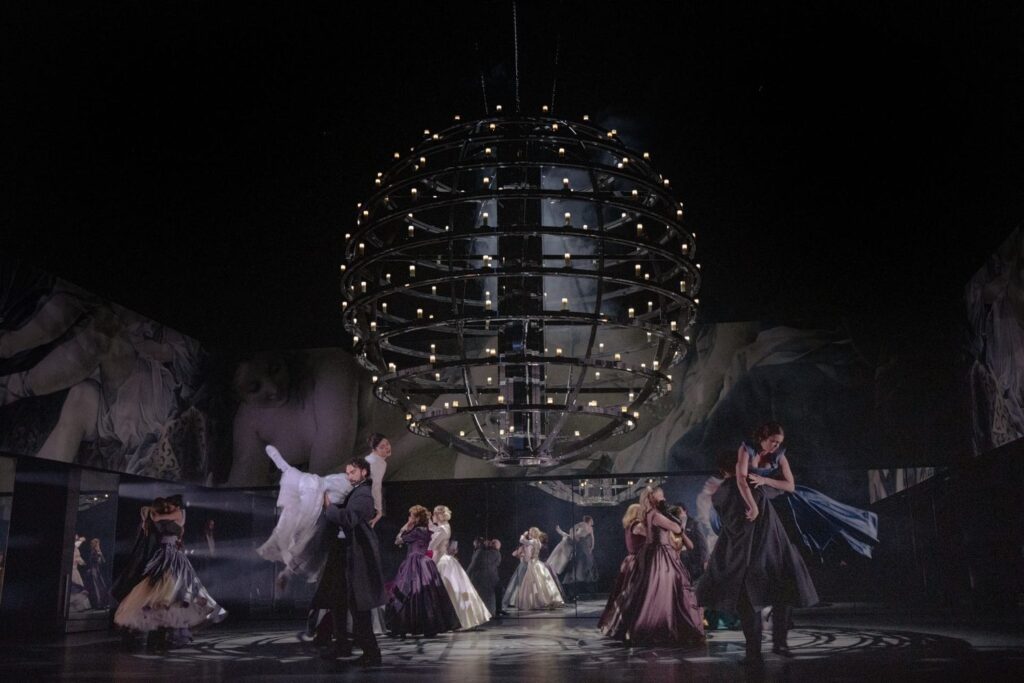
It is through movement that this structure is most powerfully brought to life. Choreography by Tom Jackson Greaves plays a central role in translating the production’s language. It does more than decorate the action; it carries an undercurrent of raw passion and desire, moving beyond the suggestion of masked ballroom ritual into something that begins to embody the repression at the heart of the drama. The fluidity of movement feels intentional, if at times slightly qualified, as the ensemble threads itself through the central narrative. Here, intimacy does not erupt; it is assembled. Gestures repeat, interactions mirror one another, and encounters unfold with a sense of pattern rather than impulse. Movement becomes a means of execution rather than expression, reinforcing the idea that seduction operates through method. The ensemble functions not as background, but as an extension of the system, echoing and amplifying its rhythms.
The visual world further supports this sense of containment. With carefully structured spatial arrangements, the staging creates a setting in which characters are constantly visible – observed not only by one another, but by the audience. Reconfiguring walls and doorways, framed by mirrors on three sides, create shifting perspectives that continually reposition the audience’s gaze. Above, a frieze of erotic female nudes and a gleaming central chandelier reinforced polished surface, even as its underlying tensions begin to reveal. The effect is less one of immersion and more one of exposure; behaviour appears orchestrated, as though governed by an unseen set of rules. This aesthetic extends into the production’s emotional core. What might initially register as a lack of intensity reveals itself as something more deliberate – a sustained act of restraint. The staging holds its characters within a steady, calibrated tension, inviting the audience to observe rather than simply feel. In place of dramatic release, it conveys continuous events governed not by impulse, but by design. It is this very containment that unsettles, suggesting patterns of behaviour that feel less confined to the 18th century than quietly recognisable beyond it. Costumes reinforce the codes of high society, capturing the elegance of the period while supporting the clarity of character and status.
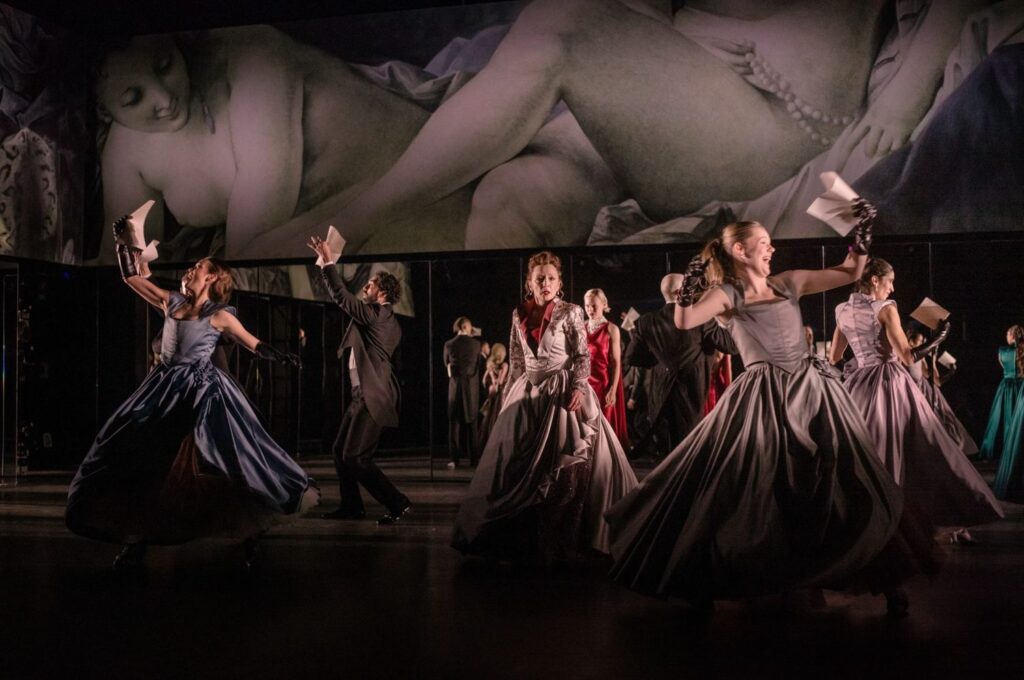
Positioned between the calculated exchanges of Laclos’ original text and the sensual immediacy of its screen adaptations, this production occupies a strikingly different mode. Here, seduction does not operate in the expected sense; it reveals its own mechanics. Nothing is left to chance. Every glance, every movement, every encounter is placed with intent. Seduction is not simply performed. It is constructed – and, in its precision, made all the more compelling to watch.
Les Liaisons Dangereuses is at the National Theatre until 6 June.


