
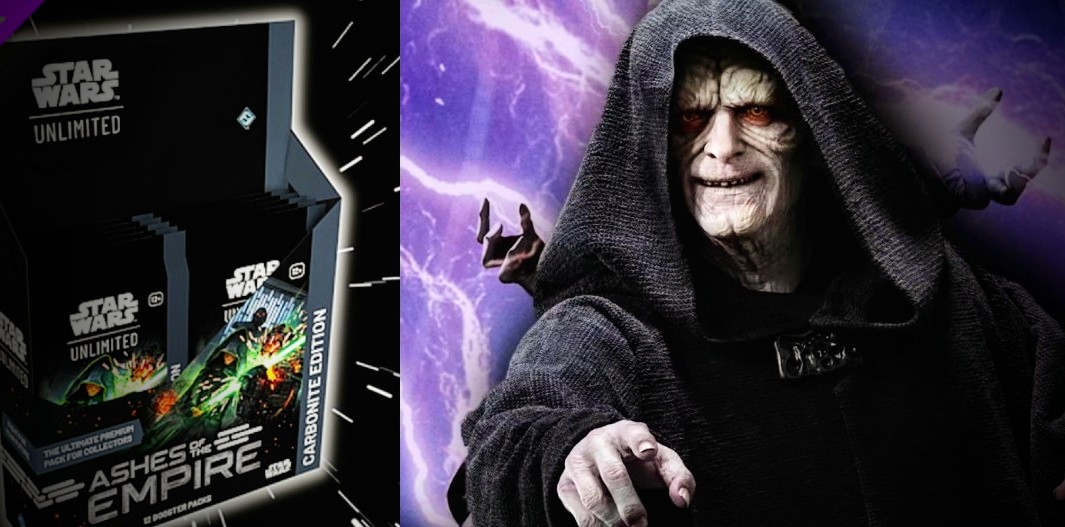
This article is about Star Wars: Unlimited TCG (Trading Card Games) Set 8: Ashes of the Empire.
There is a reason why some people are captivated by the villains of a galaxy far, far away. While heroes give you hope, the dark side offers pure, unadulterated drama. Let’s be honest: the Jedi might have inner peace, but the Sith have the outfits, the monologues, and a staggering amount of petty grudges. This July, that signature cosmic tension is coming directly to the living rooms.
Fantasy Flight Games is officially launching Ashes of the Empire, the highly anticipated eighth set for the hit trading card game Star Wars™: Unlimited. While the game captures the sprawling factions of the galaxy, it’s the looming shadow of the Sith Order that completely steals the spotlight this time around.
The Story: Managing the Chaos of a Post-Endor Galaxy
The narrative setup of Ashes of the Empire feels less like a simple card game and more like a high-stakes political thriller mixed with a corporate succession crisis. The timeline picks up immediately following the chaotic fallout of Return of the Jedi. The second Death Star has shattered, Emperor Palpatine has supposedly plummeted down a reactor shaft, and a massive power vacuum has left the galaxy in absolute freefall.
As the Rebel Alliance struggles to establish the New Republic, fractured Imperial remnants are scrambling in the dark, desperate to preserve what is left of the Sith’s terrifying legacy. It’s an era of shifting alliances and deep anxiety – the very same timeline that sets the stage for favorite live-action stories like The Mandalorian and Ahsoka. For pop-culture fans, playing through this set feels like stepping into an interactive prologue for the next wave of cinematic Star Wars movies.
Sith Workplace Culture: A Masterclass in Toxic Energy
To truly understand why the Sith dominate this expansion, you have to look at their history. Long before the events of the films, the Sith operated under the “Rule of Two” – a philosophical business model dictating that there can only ever be one Master to hold power, and one Apprentice to crave it. It is, by definition, the most toxic mentorship program in the universe. Your only career advancement involves murdering your boss.
Ashes of the Empire leans heavily into this delicious workplace drama. Even with Palpatine missing, his tyrannical HR policies live on through the game pieces. Sith characters don’t cooperate; they exploit. They view their subordinates not as allies, but as human shields or temporary stepping stones.
The Boss From Hell: Palpatine’s Ultimate Betrayal
While the game lets you channel Emperor Palpatine’s terrifying presence, any deep-lore fan will tell you that Sheev Palpatine was actually a terrible CEO for the Sith brand. For generations, the Sith survived on the Rule of Two – a philosophy built to ensure the dark side would endure through a continuous legacy of masters and apprentices. But Palpatine didn’t care about a legacy; he had a massive, myopic ego.
Instead of treating the Sith Order as a tradition to pass down, he treated it like a disposable ladder. He hoarded absolute power entirely for himself, continually breaking his own order’s rules by secretly juggling multiple acolytes, clones, and back-alley dark side puppets. In the end, his refusal to let anyone else hold the reigns didn’t just break the chain – it essentially ensured the total extinction of the Sith. He didn’t build an empire; he built a giant monument to his own vanity.
The Death Star Paradox
This brings us to what galactic historians might call the “Death Star Paradox.” Palpatine became so entirely obsessed with his massive, moon-sized superweapons that he completely destabilized the very Empire he spent decades plotting to build.
Think about the sheer math of the failure: he diverted trillions of credits, millions of troops, and endless imperial resources away from stabilizing a massive galaxy, putting all of his eggs into a single, fragile metal basket. Every time he built a planet-killer, he created an existential threat so massive that it forced the entire galaxy to unite against him. By relying on a giant laser instead of sustainable governance, his hubris practically handed the Rebel Alliance their victory on a silver platter.
The Setup: What Actually Comes inside the Box?
If you’re new to the world of Trading Card Games (TCGs), the barrier to entry can sometimes feel as daunting as navigating an asteroid field. Thankfully, Fantasy Flight Games designed Ashes of the Empire with casual collectors and kitchen-table gamers in mind.
Instead of forcing you to buy random foil packs and build a deck from scratch, the launch introduces Spotlight Decks (retailed at around £19.99). These are pre-built, balanced 50-card decks that allow two players to immediately open the box, deal the cards, and start playing out their galactic fantasies. Each box comes fully loaded with:
The Leader Card: The main character orchestrating your entire strategy (like Luke or Palpatine).
The Base Card: Your planetary headquarters that your opponent is actively trying to destroy.
A Complete 50-Card Fixed Deck: Ready-to-play with zero customization required.
Tokens, Damage Counters, and Rules: Everything you need to keep track of the battlefield drama.
A Bonus Booster Pack: A surprise pack of 16 random cards to give you a taste of expanding your collection later.
Playing with Fire: The Cruel Logic of the Dark Side
What makes Ashes of the Empire an absolute must-try for casual fans is how this cutthroat lore is baked right into its brilliant new mechanical theme:
In previous sets, upgrading your characters meant giving them permanent experience. But the Sith don’t build for the future; they consume for the moment. This expansion replaces traditional upgrades with temporary bursts of power. Your units get a massive, aggressive spike in strength, but the second they attack or defend, that power burns out entirely. It perfectly encapsulates the volatile, self-destructive nature of the dark side – immense power fueled by immediate betrayal. It’s a mechanic that practically begs you to cackle maniacally across the table.
The Spotlight Experience: For couples or friends looking for a cinematic game night, the set introduces two pre-built “Spotlight Decks” designed to be played right out of the box. You can step into the shoes of Luke Skywalker, rallying heroic forces with hope, healing, and healthy communication boundaries. Or, you can pull the strings from the shadows as Emperor Palpatine, treating your remaining forces like disposable pawns on a chessboard.
The Ultimate Sci-Fi Crossover: Palpatine vs. Burkholderia pseudomallei / ET12
For the true science-meets-sci-fi nerds, Palpatine’s insidious style of management isn’t just limited to a galaxy far, far away. In a bizarre twist of biology, the Emperor’s political playbook is identical to one of Earth’s most famous micro-pathogens: the Burkholderia pseudomallei and ET12 bacterium.
If you look at how this sneaky bug operates, it is essentially running Palpatine’s exact strategy on a cellular level:
- The Cellular “Order 66”: Upon invasion, Burkholderia forces healthy host cells to violently fuse together into single, twisted monocultures (Multinucleated Giant Cells). It’s the literal biological equivalent of Palpatine taking a beautifully diverse, democratic Republic and forcing it to merge into a supreme Galactic Empire.
- Suppressing the Light: Just as Palpatine blinded the Jedi to his presence, this bacterium turns the body’s internal defense systems against themselves, actively shutting down the cell’s ability to trigger an immune warning flare. It effectively cloaks itself in the dark side, leaving the host totally blind to the threat.
- Pure Hubris: Palpatine hides his catastrophic power behind the facade of a frail old man. Burkholderia does the same, masquerading as completely harmless soil bacteria thriving passively in warm mud – right up until the conditions shift, and it unleashes its Tier 1 bioweapon capability.
Why the Micro-Chaos Matters: The Road to the GTCs
This chaotic, volatile philosophy doesn’t just make for great lore – it is about to put the real world into a tailspin. Because Ashes of the Empire hits shelves on July 17, players have a razor-thin window to master this volatile dark side energy before the 2026 Star Wars: Unlimited Galactic Championship (GTCs) kicks off in Las Vegas on July 24.
Top competitors aren’t just fighting the light side; they are trying to figure out how to pilot – and survive – a ruthless, unpredictable new competitive environment. Whether you are dealing with a microscopic pathogen or a tyrant in a hooded cloak, the rule remains the same: the things lurking in the dirt are always the most dangerous.
Why It Belongs on the Coffee Table This Month
Tabletop gaming has officially transitioned into a modern lifestyle staple. It’s no longer about memorizing massive, dry rulebooks; it’s about spending an atmospheric evenings competing.
With its polished, comic-book-inspired card art and narrative-forward design, Ashes of the Empire offers the perfect excuse to pour a glass of wine, clear off the coffee table, and find out exactly what happens when the fragile balance of the galaxy rests entirely in your hands. Just remember to watch your back – if the Sith have taught us anything, it’s that someone is always eyeing your chair.
Prerelease Hype: July 10 – July 16, 2026 (Check local hobby shops for early kits)
Official Worldwide Launch: July 17, 2026


