Madfabulous made its world premiere at the 40th edition of BFI Flare, bringing to screen the extraordinary life of Henry Paget, the 5th Marquess of Anglesey, a flamboyant aristocrat who lived at the end of the 19th century.
HersToday spoke with the film’s writer, Lisa Baker, about the film’s narrative, her research process, and redefining the relationships at its heart.
“I couldn’t believe it,” Baker says. “He was the most exotic person in the world that I’d never heard of.” Originally from Holyhead, Anglesey, Baker was approached by director Celyn Jones to develop the screenplay. What struck her immediately was the contrast: a figure of theatrical excess and global intrigue, yet largely unknown in modern day within the very landscape he inhabited. Jones, she explains, offered her complete creative flexibility from the outset. “There were no restraints. He trusted me to go into the research and bring something of my own to it.”
Rather than relying on conventional biographies, Baker grounded her work in archival material – most notably the catalogues from what was described as the “sale of the century”, a series of auctions through which Henry Paget’s possessions were dispersed. These catalogues became a point of entry into the character. Through lists of unworn garments, luxury items, and personal belongings, a psychological portrait began to emerge. “You start to see the scale of it; the sheer volume, the extravagance. From that, you begin to ask: what kind of person owns these things?” Alongside this archival approach, Baker developed a more immersive process, building an extensive music playlist that allowed the story to evolve beyond the page. “Even when I wasn’t writing – if I was driving or cooking – I’d have the playlist on. It helped me think about the characters and the relationships between them.”
The film’s timeline also reflects deliberate narrative decisions. While Henry Paget’s life began in Wales much earlier, the story concentrates on a ten-year period, allowing continuity in performance while maintaining emotional focus. “I pushed for seeing Henry over ten years. We brought him to Wales at eighteen rather than eight.” Flashbacks, particularly those involving his mother Blanche, anchor the film thematically. “She was the one who left that lasting impression – that he should be true to himself. That carries through everything.”
Despite her detailed knowledge of the subject, Baker is careful not to impose interpretation onto the cast. “I never tell actors what to do – I’m not an actor. But I made myself available. When they had questions, we could have a full and frank conversation.” This openness extended to the development of Lily’s character, whose emotional position operates in contrast to Henry’s volatility. “She has to be his strength. He’s so flamboyant, so changeable – and she endures. She loves him, but she knows he will never love her in the way she wants.”
At the centre of the film is a relationship that does not fit any straightforward categorisation. Rather than presenting it through a conventional romantic lens, Baker approaches it as something more nuanced. “My interpretation was that theirs was a loving relationship, but a platonic one.” She draws on contemporary parallels to articulate this dynamic – relationships formed out of mutual needs and understanding, rather than desire. “I’ve always been interested in the idea that you can build a life together without it being sexual.”
Within the social context of the time, the marriage also reflects expectation and pressure. Henry is expected to conform; Lily requires stability. Their union, in this reading, becomes both pragmatic and emotionally complex. “I don’t believe there was ever a sexual motive behind their relationship.” For Baker, bringing this dynamic to the screen is not incidental, but intentional. “Platonic relationships like this exist everywhere in society. They’re loving, they’re important – but they’re often not celebrated.”
Although the story is anchored in North Wales, it carries a distinctly contemporary resonance. The landscape is not just a backdrop, but part of the film’s identity – setting the tone and allowing it to speak beyond its setting. “There’s something about Anglesey,” Baker reflects. “People say there are ley lines there.”
Through a combination of archival exploration and instinctive storytelling, Baker writes a narrative that reaches beyond historical retelling. Instead, Madfabulous presents a portrayal of identity, performance, and connection through a mercurial character living an extraordinary lifestyle.
Xiaodan He is a Montreal-based filmmaker and director whose work draws from her experience as a Chinese immigrant in Canada. Having spent over two decades in the city, her storytelling is shaped by the textures of culture, identity, and place. Montreal, My Beautiful follows her first feature and continues in this direction, centring narratives revolve around adaptation and integration. Presented at BFI Flare as its first European premiere, the film brings a distinctly Montreal-set story onto an international stage, while remaining loyal to the specificity of its characters.
It follows Feng Xia, a middle-aged Chinese woman living within a structured routine, defined by long-established habits and expectations. Her days move between domestic responsibilities and a steady, familiar rhythm that leaves little space for variation, or genuine passion. That begins to change when she meets Camille, a younger woman whose self introduces a different tempo and energy to Feng Xia. Through their bond, Feng Xia starts to shift slightly beyond the edges of her existing life, stepping into spaces that feel unfamiliar, yet quietly compelling.
Following the screening at BFI Flare, Xiaodan He joined for a Q&A, reflecting on the film’s origins, its characters, and the thinking behind it. She described the project as a natural extension of her own connection to Montreal – a city she has called home for more than 20 years. Drawing from that proximity, the story takes shape through a lens of lived experience.
At its centre is Chinese immigrant life, approached through a more specific viewpoint: a middle-aged Chinese woman. This perspective, she noted, offered a less commonly seen entry point, allowing the story to unfold in a way that feels registered without detachment from reality. In writing Feng Xia, He spoke of a balance between simplicity and being bold. The character carries a vague confident quality, one that allows her to move forward even in the face of uncertainty. While bound by cultural expectations, family dynamics, and routines, her journey is not packaged through overt conflict. Instead, it unfolds in small progression, through moments of curiosity, subtle changes in behaviour, and a growing openness to the unfamiliar.
For the lead role, He was introduced to Joan Chen through a mutual, long-time collaborator. After reading the script, Chen responded swiftly to the character of Feng Xia and agreed to take on the role. In preparation, she learned French over several months, working with a language coach alongside her other commitments – a detail that reflects the film’s rooted in Montreal’s everyday linguistic-driven landscape.
Writing, Dialogue & Character Tension He described the script as something developed across multiple drafts, allowing space to refine both structure and dialogue. Her focus remained on precision; keeping exchanges concise, with meaning carried through shorter, more direct lines rather than extended dialogue. Each character’s voice was written with attention to tone and manner, giving them distinct flavour and ways of speaking. With limited rehearsal time, He relied heavily on instinct during filming, making quick decisions while staying closely anchored to the script.
When speaking about the lead character, Feng Xia, He noted her constant swaps between hesitation and action. There is an awareness of the unknown, but also a steady pull forward; not toward resolution, but toward motion itself. That balance snugs quietly at the core of the film. The film lingers on small decisions, subtle gestures, and moments of pause.
At the end of the day, Montreal, My Beautiful remains a constant reminder – never overstated, yet always there -telling a story that moves gently, favouring its natural shifts over dramatic turns.
Across different stages of life, questions of identity do not necessarily begin or end at a fixed point. For some, they emerge early, taking shape through observation, emulating, and uncertainty. For others, they may resurface later under different circumstances. At the 40th BFI Flare, Big Girls Don’t Cry and Montreal, My Beautiful both zoom in on this ongoing process, though different in setting and life stage. One follows a teenage girl at the early stages of self-discovery, navigating feelings she does not yet fully understand. The other focuses on a middle-aged woman who finds a sense of self-discovery outside the structure of an established life. Both protagonists have male figures in their respective lives; one creates confusion, the other containment. One struggles to understand desire, the other struggles to interpret it. Together, the two films beautifully present identity not as a resolved state, but as something that continues to evolve, and experienced.
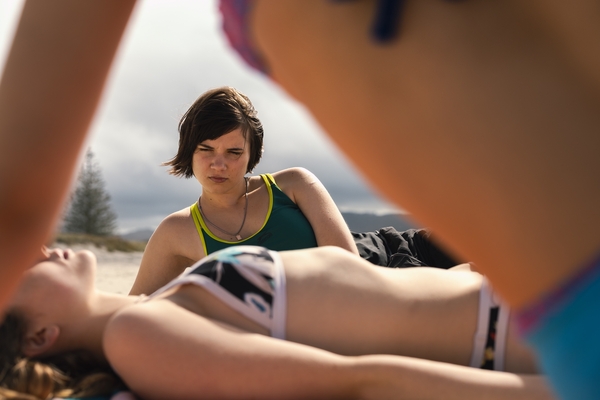
Big Girls Don’t Cry is a coming-of-age film that takes place over the course of a single summer in 2006, following Sid, a 14-year-old girl living in a small town in New Zealand. The film centres on her day-to-day experiences as she navigates friendships, family dynamics, and shifting social environments during a transitional stage of adolescence. Sid (a striking breakout performance by newcomer Ani Palmer) spends much of her time observing and interacting with a group of older teenagers, Lana (Beatrix Rain Wolfe), the popular girl in particular, whom Sid is somewhat infatuated with. Wanting to be included, Sid begins to adopt the behaviours she sees around her. Sid spends much of her time with her close friend Tia (Ngataitangirua Hita), though their dynamic changes due to Sid being part of the older group. She joins in drinking alcohol, smoking pot, and partying, gradually asserting herself into situations that feel unfamiliar but are perceived as necessary for social acceptance, including flirting with a trio of city boys. These moments are part of the social world she’s stepping into, and she moves through them cautiously, still figuring things out as she goes. Her attention is gradually drawn toward Freya (Rain Spencer), an American friend of her sister, Adele (Tara Canton). Their interactions are more low-key and comfortable, often playing out in secluded spaces or brief moments together, without anything being openly said about how Sid feels. Freya introduces a different kind of mixed social energy into Sid’s world. As the summer progresses, Sid navigates between different settings and gatherings, each bringing her different exposure to new experiences. Her interactions with her father Leo (Noah Taylor) – a struggling former artist now working as a mower, whose alcoholism at times leaves him emotionally absent – are marked by a mix of routine exchanges and moments of tension. Meanwhile, Tia’s older brother Diggy (Poroaki Merritt-McDonald) is an older boy who adds dynamic to Sid’s summer exploration. The cool kids group consists of Lana, Stevie (Sophia Kirkwood Smith), and the boys they met at the beach: Kyle (Ian Blackburn), Andy (Emile Boyle), and Willy (Caleb Cameron Lee). Things take a turn when Sid sees Freya in an intimate moment, which changes something in her. The film follows Sid through a series of small moments rather than culminating in one big event, with beach scenes, parties, and encounters building up over the summer as it plays out. Paloma Schneideman’s debut feature leans into a reflective, measured approach, creating a narrative through a sense of hindsight that brings a certain emotional clarity. Overall, Big Girls Don’t Cry is a slow-moving yet fascinating portrait of adolescence defined by observation and natural shifts in awareness. The film takes the audience through small interactions and changes in behaviour with a superbly natural performance by the leading cast, while the supporting cast reinforces its subtle tone. Schneideman refreshingly keeps the focus on lived experience rather than resolution, allowing moments to go by without emphasis. The film ends with Sid seizing the day, where her sense of self is starting to mature but is still largely unspoken.
At the other end of the spectrum, Montreal, My Beautiful follows a 53-year-old Chinese immigrant living in Montreal who’s beginning to experience resurfaced emotions. The film centres on her daily life, led by routine, family responsibilities, and the expectations that come with maintaining a household. Much of her time is spent between domestic spaces and a close-knit Chinese expat community environment, where her role within the family is clearly defined. Directed by Chinese-Canadian filmmaker Xiaodan He, Montreal, My Beautiful revolves around Feng Xia (Joan Chen), who has been living in Montreal for fourteen years with her husband Jun (John Xu), with whom she runs a small convenience store, while raising their two children, Joy (Pei Yao Xu) and Dong Dong (Anzhe Angelo Zhang). Her life is structured by typical family duty and expectations. Seeking to improve her French, Feng Xia enrols in a language class, where she meets Joseph (Zion-Luna Ribeaux Valdès), a young queer man from Cuba who has moved to Montreal for love. She begins to reflect on her past, including feelings connected to a childhood friendship that were never fully explored. After being introduced to online dating, she takes steps into unfamiliar territory and eventually meets Camille (Charlotte Aubin), a Québécoise woman. As her interactions with Camille become more intense, the balance between the two sides of her life becomes increasingly intricate. She continues her routines at home and at the shop, responsibly maintaining her roles as a wife and mother. Feng Xia and Camille’s interactions deepen as Camille’s openness and ease create a contrast to Feng Xia’s more reserved and routine-driven life. Over time, this develops into a more intimate dynamic, with moments of both emotional and physical connection. The film does not hinge on a single turning point, although there is a life-changing decision made by the family following the events. However, the film maintains its neutrality without forcing a clear resolution, allowing her story to remain open-ended.
BFI Flare returns to London this March for its 40th edition, running from 18 to 29 March at BFI Southbank. Over forty years, the festival has grown from a small specialist showcase into one of the most widely recognised LGBTQIA+ film festivals in the world. This anniversary edition reflects on that journey while keeping its attention firmly on the present. The 2026 programme brings together new films from across the globe alongside talks, retrospectives and events that trace how queer cinema has shifted, expanded and increasingly intersected with the mainstream.
This year’s selection includes features and shorts from nearly fifty countries, with a strong showing of world and UK premieres. Rather than grouping films by fixed identity categories, Flare continues to organise its programme around themes. Hearts, Bodies, Minds and Treasures offer loose points of entry, making the festival easy to navigate for first time visitors as well as returning audiences. The result is a programme that speaks not only to queer experience, but to anyone interested in relationships, social change and contemporary storytelling.
The festival opens with Hunky Jesus, a high energy documentary centred on San Francisco’s Sisters of Perpetual Indulgence. It is playful and political in equal measure, grounded in activism and community, and sets an open, confident tone for the days ahead. The Special Presentation, Big Girls Don’t Cry, moves in a quieter direction. Set in early 2000s New Zealand, it follows a teenager through a summer of emotional uncertainty and first awakenings, capturing the intensity of that age without forcing the drama. The festival closes with Black Burns Fast, a South African boarding school drama that explores friendship, attraction and self discovery with warmth and momentum.
Much of the programme’s emotional core sits within the Hearts strand, which looks at love and connection in all their complicated forms. Amantes offers a sharp and contemporary take on lesbian dating in Paris. Another Man focuses on adult restlessness and the pull of unexpected attraction. ìfé: (The Sequel) reconnects with characters from Nigeria’s first lesbian feature, checking in years later to see how time and compromise reshape intimacy. Elsewhere, The Little Sister explores sexuality and faith through the eyes of a French Algerian teenager, while Washed Up blends romance and folklore against a rugged Cornish coastline.
The Bodies strand turns attention toward physicality, transformation and how identity is lived day to day. Films here range from naturalistic dramas to more stylised and experimental work. Bearcave traces the emotional undercurrents of a long standing friendship between two girls. Body of Our Own follows resilience and sisterhood over an extended period of time. Other titles use genre, fantasy or heightened visuals to explore how people inhabit their bodies and desires, rather than trying to define them neatly.
In Minds, the focus widens to questions of culture, memory and collective experience. These films tend to step back and reflect, looking at art, politics and representation through personal and historical lenses. Several documentaries revisit influential figures or reconsider familiar cultural moments, asking who shapes narratives and whose voices are allowed to endure.
Alongside the feature films, BFI Flare’s short film programmes remain a highlight. They showcase emerging filmmakers and a wide range of styles, from intimate realism to playful experimentation. The festival also continues Five Films for Freedom with the British Council, making a small selection of shorts available to watch online worldwide. It is a simple but pointed reminder that access to storytelling is still uneven, and often contested.
At forty, BFI Flare feels less like a niche event and more like a broad cultural meeting place. While rooted in queer experience, the 2026 programme reaches outward, engaging with universal questions of identity, belonging and connection. It is a festival that invites curiosity, whether you are deeply familiar with queer cinema or simply looking for films that reflect the world in all its complexity. Explore Flare programme
Whittaker brings a commanding presence to her role, embodying the Duchess’s fierce spirit and determination of someone who clearly knows the fact that she is above her accuser’s rank. This knowing represents itself in a portrayal that captures the essence of a woman who refuses to be subjugated, despite the overwhelming odds stacked against her.
Jodie Whittaker’s return to London’s West End’s stage in Zinnie Harris’s adaptation of The Duchess of Amalfi is both a thrilling and thought-provoking experience. This modern interpretation of John Webster’s Jacobean tragedy, now set against an ambiguous contemporary backdrop, explores themes of power, control, and survival in a world imagined by patriarchal forces. While the production fills with unevenness, it ultimately illuminates the grim realities of those seemingly in power, and the resilience of those they attempt to oppress. In this retelling, the central narrative remains rooted in Webster’s original tale of a noble widow who – after years under the regime of a husband who was extremely controlling – secretly marries her servant. The consequences of her desire for autonomy are tested, as she faces ruthless demands and persecution from her brothers.
Harris’s adaptation makes a bold choice by integrating modern elements such as contemporary language, swearing, cross-dressing and musical interludes, while maintaining the play’s original tension. The production opens with a striking industrial set designed by Tom Piper, featuring white metal gantries that evoke a stark, clinical environment. This not only reflects the coldness of the characters’ motivations but also serves as a literal structure for surveillance and control, reinforcing the theme of a dystopian flavour. The staging is marked by clever directorial choices that enhance the fluctuation and stakes of the story. Scenes of domestic violence and psychological torment are amplified through strobing lighting and sound effects. Ben Ormerod’s lighting creates shadows that engulf the stage during pivotal moments, visually representing the dark theme. Similarly, the use of music – initially intrusive – gradually transforms into a haunting requiem, echoing the sorrow and tragedy that envelops the bloodbath ending of the story. The first act seems cluttered with exposition, as characters often articulate their emotions and motivations somewhat explicitly. Lines such as “I am not her equal” and “I’m impulsive and headstrong” detract from the subtleties that could have been conveyed through action and expression. Perhaps complex fluidity and nuanced dynamism are more expected from a production of this calibre. As the play progresses into the second act, it finds its footing, drawing audiences into the horror of not only the Duchess’s, but everyone else’s fates. Whittaker’s performance truly shines in the later scenes, as she navigates the psychological torture with climactic moments that are visceral. Whittaker delivers Webster’s iconic line, “I am the Duchess of Malfi still,” with a defiance that resonates deeply, leaving an indelible mark on the audience.
The character dynamics, particularly between Whittaker’s Duchess and the men who seek to control her, are intriguing. Rory Fleck Byrne’s Ferdinand is portrayed with an unsettling intensity, embodying the brutal and destructive nature of his incestuous desires and secret longing for approval from his fiery twin. Paul Ready’s Cardinal offers a chilling performance, steeped in hypocrisy and moral depravity, as he navigates his relationships with the women in his life. Their moral corruption and personal desires, masked by a facade of righteousness or duty, emphasise the destructive consequences of patriarchal hypocrisy. The play critiques how this false morality not only harms the Duchess but ultimately consumes and backfires to the perpetrators. The ensemble cast – including Jude Owusu, Elizabeth Ayodele, Hubert Burton, Matti Houghton, Hannah Visocchi, Kerill Kelly, Greg Snowden, and Amy Vicary-Smith – supports these lead performances with each interpretation, adding depth to the oppressive environment that surrounds the Duchess. The interactions between these characters reflect the broader themes of power, superficiality and vulnerability that permeate the narrative. The attempts to merge different tones – Tarantinoesque violence with solemn tragedy – can feel jarring at times, leaving the audience uncertain about the intended emotional response. Some moments of levity, while intended to offer relief, clash with the overall somber tone of the play. Yet, amid the chaos and bloodshed, there is a glimmer of hope. The heir of the Duchess survives, symbolising resilience and balance. The survival signifies inner power against the oppressive forces that seek to destroy those who dare to defy societal norms. While the lives of the protagonists are marred by tragedy, the continuation of the bloodline offers a sense of renewal, hinting that the cycle of violence will – with no question – eventually be broken. This crucial aspect of the narrative serves as a reminder that while the struggle for power may lead to tragic ends, the potential for survival and renewal remains. It is a testament to the enduring spirit of those who refuse to be defined by their circumstances. Overall, The Duchess of Malfi presents a bold, relevant and ambitious reimagining of a classic text. The cast’s powerful performances anchor the production, bringing to life characters whose struggle against patriarchal forces can make a difference. The adaptation portrays the desperation of those in positions of authority who attempt to control others but lack true substance or inner strength. This theme suggests that hollow power ultimately leads to self-destruction, as seen in the tragic ends of the Duchess’s brothers. They are motivated by dominance but are revealed as empty in their purpose and humanity. It effectively hints at the play’s exploration of empty, oppressive power structures and their inevitable downfall. Its depiction of power dynamics and the fight for autonomy resonates, ultimately inviting audiences to reflect on the complexities of control and survival, pinpointing the unnecessary and destructive legacies the world should leave behind.
The Duchess [of Malfi] is currently running at Trafalgar Theatre until 20th December 2024.
As a founder, International Women’s Day has always felt less like a celebration and more like a checkpoint. Each year on 8 March, International Women’s Day prompts a useful question: is the current designing organisations genuinely convert talent into results; or is it still relying on outdated structures and hoping motivated people will compensate for inefficiency? The 2026 theme, Give to Gain, may resonate because it speaks to systems, not sentiment. In business, nothing scales on goodwill or giveaway alone. What scales are clear rules, strong incentives, and environments where capable people are motivated and can perform without unnecessary friction. From a founder’s perspective, modern work design is no longer a cultural debate.
Why founders see the cracks first
Founders live close to consequences. When work design fails, it shows up quickly – in missed deadlines, decision bottlenecks, talent churn, chaos or leadership fatigue. Unlike large institutions, founders do not have the time to be absorbing inefficiency indefinitely. Women founders, in particular, tend to notice where traditional work models leak value. Linear career assumptions, rigid availability expectations, and performance measured by visibility rather than outcomes all create drag. Not because standards are too high, but because they are misaligned with how high-skill work is actually delivered. Over time, these inefficiencies quietly push capable women out, not due to lack of ambition, but because the cost, benefit equation stops making sense.
The Give to Gain idea is often misread as giving away advantages or soft leadership. In reality, it reflects something founders understand well: strong systems reduce dependency on rhetorics.
Giving, in this context, looks more like:
Senior leaders sponsoring proven performers into decision-making roles
Clear commercial pathways for women-led contractors, suppliers and partners
Knowledge-sharing that reduces single points of failure
Transparent rules that allow merit to surface without politics
This is not about lowering the bar. It is about removing noise so performance can be assessed cleanly. When systems are fair and legible, competition improves and trust compounds.
What this means for professional hires
For professional women inside organisations, modern work design is equally consequential. High performers do not need constant flexibility; they need predictability, autonomy, and clarity. Well-designed environments: Reward judgement and delivery over constant availability. Offer progression paths that accommodate non-linear growth. Respect cognitive load and responsibility outside work. Retain experienced talent rather than burning it out. From a leadership standpoint, this is not accommodation, it is risk management. Losing mid-to-senior women due to poor design is costly, avoidable, and strategically short-sighted.
Redefining ambition without diluting standards
Ambition has not disappeared. It has matured. Increasingly, women – founders and professionals alike – are optimising for durability: careers that compound expertise, credibility, and economic return over time. That requires environments where effort converts reliably into outcomes, and where authority matches responsibility. Founders who design work intelligently gain more than loyalty. They gain better decisions, stronger execution, and leadership depth that survives growth phases and market cycles. Practical checkpoint, not a performance. International Women’s Day should not be a branding exercise. For founders and serious organisations, it is an opportunity to audit structure: how decisions flow, how talent progresses, and whether incentives reward contribution or optics. This year, Give to Gain signals a more grounded conversation – one that recognises that when women operate inside well-built systems, the gains are measurable. Stronger companies. Better leadership. More prosperous.
The BAFTA Film Awards 2026 took place at London’s Royal Festival Hall, bringing together the year’s most prominent films, performances, and creative teams from across British and international cinema.
The ceremony reflected a year marked by literary adaptations, large-scale studio productions, and director-driven storytelling, with awards distributed across a broad range of genres and styles.
Best film and major wins
The evening’s top honour, Best Film, went to One Battle After Another, which also secured wins in Best Director, Best Editing, Best Cinematography, and Best Adapted Screenplay. Directed by Paul Thomas Anderson, the film emerged as the most awarded title of the night.
Hamnet also featured prominently, winning Outstanding British Film and Best Leading Actress for Jessie Buckley, alongside multiple technical nominations.
Acting awards
In the leading categories, Robert Aramayo received Best Leading Actor for his role in I Swear, a performance that also earned the film Best Casting.
The supporting performance awards went to:
Wunmi Mosaku for Sinners (Best Supporting Actress)
Sean Penn for One Battle After Another (Best Supporting Actor)
The EE Rising Star Award, voted for by the public, was also awarded to Aramayo, marking a standout year for the actor.
Direction, writing, and international cinema
Best Director was awarded to Paul Thomas Anderson, while Best Original Screenplay went to Ryan Coogler for Sinners.
In the international category, Sentimental Value, directed by Joachim Trier, won Best Film Not in the English Language.
Technical and creative categories
Several films dominated the craft awards:
Frankenstein won Best Production Design, Best Costume Design, and Best Make Up & Hair
Avatar: Fire and Ash won Best Special Visual Effects
F1 won Best Sound
Sinners won Best Original Score
Animation, documentary, and British debuts
In animation, Zootropolis 2 was awarded Best Animated Film, while Boong won Best Children’s and Family Film.
Mr Nobody Against Putin received Best Documentary, and My Father’s Shadow won Outstanding Debut by a British Writer, Director or Producer.
Special honours
The ceremony also recognised outstanding contributions to the industry. Clare Binns received the Outstanding British Contribution to Cinema Award, while Donna Langley was honoured with the BAFTA Fellowship.
A year reflected in cinema
BAFTA 2026 showcased a film landscape shaped by strong directorial voices, literary adaptations, and technical ambition. With wins spread across independent, British, and international productions, the awards highlighted both creative range and industry depth, offering a clear snapshot of cinema as it stands heading into the year ahead.
Throughout history, women’s bodies have been shaped, confined, and controlled by fashion. From the restrictive corsets of the Victorian era to the modern-day bra, these garments have served as both physical and symbolic cages. While the corset fell out of favour in the 20th century, its legacy lives on in the bra – a garment still marketed as essential for support, modesty, and femininity. But just as women once stirred and opposed against the corset, a fresh wave of change is here: Opting for less restrictive alternatives is becoming a movement toward embracing body autonomy. The story of the bra is not just about comfort and practicality. It’s a story about social expectations, gender norms, and bodily autonomy. To understand why so many women are ditching their bras and look for alternatives today, we must first look at the history of this so-called necessity and how it came to symbolise both restraint and oppression.
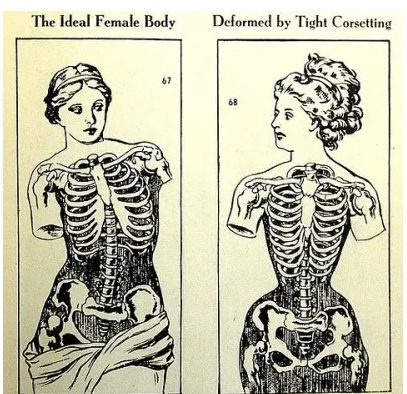
From Corset to Bra: The Evolution of Bodily Control In the 16th century, the corset emerged as a staple of women’s fashion. It was designed to shape the torso into the desired hourglass figure, with a cinched waist and lifted bust. Corsets were often laced so tightly that they caused fainting spells, difficulty breathing, and even death in extreme cases. For centuries, women endured this discomfort because society dictated that their worth was tied to their appearance. But corsets weren’t just for women. In Georgian Britain and pre-Revolutionary France, certain men of the upper classes also wore corsets to achieve a fashionable, narrow-waisted silhouette. These men’s corsets reinforced rigid beauty standards for both genders, symbolising that even men’s bodies were subject to control. By the early 20th century, the corset fell out of fashion, replaced by the brassiere – a more modern, less restrictive undergarment. But the bra, like its predecessor, quickly became more than just a practical garment. It became a symbol of femininity and respectability, marketed as essential for shaping the body to meet societal standards. The transition from corset to bra was seen as a step toward liberation. But was it really? Or did the bra simply become a more socially acceptable cage? Corsets not only shaped fashion but also had a profound impact on the skeletal structure of those who wore them. An anthropological study featured on Lucy’s Corsetry highlights how prolonged corset use caused skeletal deformities, including ribcage compression and spinal curvature. Despite these significant changes, many wearers lived beyond the average lifespan of their era. This study sheds light on the physical toll of these garments and how societal beauty standards influenced women’s health. For more details, visit here Historical X-rays further reveal the shocking impacts of corset-wearing on women’s bodies, from deformed ribcages to displaced organs. Read more here
Corsetry Beyond Europe: Binders and Body Shaping in Asia While corsets are often associated with European fashion history, body-shaping garments existed in other regions as well. In Minoan Crete around 1600 BCE, women wore garments resembling corsets, known as strophions, which emphasised the waist and supported the bust. However, in Asia, body shaping took a different form. Instead of rigid corsets, women in some cultures used binders – tight-fitting garments designed to shape the body without the extreme compression of European corsets. In China, for instance, binders were used to flatten the chest and achieve a slim, graceful silhouette that was considered elegant and modest. Unlike the Western corset, these binders were often seen as practical rather than decorative. They provided a way to control the body’s shape while maintaining the flow and elegance of traditional garments. The perception of these garments was different from that of corsets in Europe, as they were often worn for functionality and modesty rather than as tools of societal control. This variation in body-shaping practices highlights the cultural differences in how women’s bodies have been perceived and controlled throughout history. While European corsets symbolised oppression and conformity, binders in Asia were often more about pragmatism and cultural ideals of beauty and modesty. However, the underlying theme remains the same: women’s bodies have long been subjected to external standards and expectations.
Social Expectations: The Bra as a Symbol of Conformity The bra has long been marketed as a necessity for women. From a young age, girls are taught that bras are essential for modesty, support, and attractiveness. The message is clear: a woman’s natural body is not acceptable as it is. It must be shaped, lifted, and concealed. Over the decades, the bra became a symbol of social conformity. Women who went braless were often labelled as hippy, rebellious or inappropriate. Even today, going braless in certain settings – like the workplace – can be seen as unprofessional or provocative. This expectation is rooted in society control over women’s bodies. Just as the corset symbolised a woman’s place in society – confined, controlled, and decorative – the bra continues to reinforce outdated ideas about what women should look like and how they should present themselves. However, this narrative is shifting. Open-minded women and younger generations, are increasingly moving away from these confined social norms. For them, going braless is a statement of bodily autonomy and self-acceptance.
The Technical Side: Do We Really Need Bras? The primary argument in favour of bras is that they provide support, and to lift up – particularly for women with larger breasts. But do bras really prevent sagging, or is this just a myth perpetuated by the lingerie industry? Studies show that bras may actually weaken the muscles that support the breasts, leading to more sagging over time. Without the constant reliance on a bra, these muscles can strengthen, providing natural support.
Braless and other viable options Although going braless can pose issues for some people, there are several benefits to doing so. For starters, not wearing a bra is believed to improve muscle tone. According to Dr. Brynna Connor, “Not wearing a bra forces the muscles in your chest and back to work harder to support your breasts, and this engagement may lead to improved muscle tone over time.” However, research surrounding this aspect of breast health is still inconclusive, and individuals should remain vigilant about how their bodies feel. Going braless can also promote skin health. Bras, especially those that are too tight or poorly fitted, can cause sweat to build up under the breasts, leading to bacterial or fungal infections. Dr. Connor notes that going braless, even for short periods, can help prevent painful chafing and rubbing along the shoulders, ribs, and back. Another expert, Dr. Shapiro, confirms that there are no known health risks associated with not wearing a bra. “There is no ‘wrong’ answer,” he says. “If you’re comfortable and confident without a bra, that’s fine.” However, he notes that individuals with larger breasts may experience back and neck pain due to the weight of the breasts, which can be alleviated by wearing a supportive bra.
Step-by-Step: Wearing a Corset or Bra
Putting on a Corset: The wearer wraps the corset around the torso, tightening the laces at the back. This process compresses the chest and abdomen, forcing the ribs inward and restricting the lungs’ ability to expand fully.
Putting on a Bra: The bra is worn by securing the straps over the shoulders and fastening the band around the chest. The underwire or elastic band provides support by pressing against the ribcage, shaping the breasts into a lifted position.
Immediate Effects: Both garments restrict natural movement of the chest and ribcage. This compression can cause discomfort, limit deep breathing, and create pressure points that can lead to pain over time.
Long-Term Effects: Prolonged use of corsets or bras can cause muscle weakness, as the body relies on the garment for support. For corsets, the damage was more severe – long-term wear could result in deformed ribs, displaced organs, and reduced lung capacity. While modern bras are less extreme, they still contribute to weakened chest muscles and potential skin issues.
For individuals with larger breasts or those experiencing discomfort, alternative support options like compression tops or adjustable bandeaus can provide relief without the rigid structure of traditional bras or corsets.
The Psychological Toll of Wearing a Bra Beyond the physical discomfort, bras can take a psychological toll on those who wear them. The constant awareness of one’s body, the feeling of being constrained, and the societal pressure to conform to beauty standards can impact self-esteem and body image. Historically, the corset was seen as a symbol of women’s oppression. It was a tool of social control, forcing women to conform to an idealised image of femininity. In extreme cases, women died from the effects of tightlacing – fainting, broken ribs, and internal damage were common. While modern bras are less extreme, the underlying message remains the same: women’s bodies need to be controlled and shaped to meet societal expectations. The principle is similar to the concept of placing a leash on pets or farm animals – it’s a method of imposing control by restricting natural movement and behaviour. Going braless or opt for alternatives, then, becomes an act of shredding this undermining of other people’s and gender’s purpose – a way to reject the notion that our natural bodies are not good enough and desperately and constantly require such a restrictive tool to function. The fact is entirely the opposite.
Endorsements: Real Women’s Experiences Going Braless Many women are embracing the freedom of going braless and sharing their personal experiences of body liberation. Here are a few stories from women who have enjoyed their body liberty: – Helen Down, a journalist, at 51 years of age decided to ditch her bra for an entire weekend. She shared that the experience was liberating and led her to feel more confident in her own skin. Although she initially felt self-conscious, she realised that most people didn’t notice or care. Helen noted that going braless gave her a sense of joyous freedom, especially during activities like cycling and dancing.
– Gabrielle O’Hagan decided to go braless for a day and shared her mixed feelings about the experience. While walking through her neighbourhood, she felt self-conscious about the visibility of her nipples. However, she found the experience empowering during a night out in the city. Gabrielle reflected on society’s double standards regarding women’s bodies and expressed her determination to continue embracing her natural form, despite the challenges. These stories highlight that going braless can be both freeing and challenging.
The key takeaway? Body liberation is a deeply personal journey, and each individual should feel empowered to make their own choices.
Technical analysis on the downsides of wearing a bra: While personal stories highlight the emotional liberation of going braless, it’s equally important to understand the physical and scientific implications of wearing bras over long periods.
Biomechanical Implications: Musculoskeletal Health. Muscle atrophy and postural dysfunction caused by long-term bra usage. Studies have suggested that relying on external support (a bra) can weaken the pectoralis muscles and cause back and neck strain, especially in larger-breasted individuals. Disruption of natural biomechanics: How bras prevent natural breast movement, reducing muscle engagement.
Spinal alignment and posture: How constant use of tight straps and bands can pull on shoulders and affect spinal health over time.
Circulatory and Lymphatic System Blockages: Tight bras, especially underwired or poorly fitted ones, may impede lymphatic drainage in the breast area. The lymphatic system is responsible for removing toxins and waste from tissues, and when it’s compressed, there could be a build-up of toxins.
Long-term effects on breast tissue health. Connection to inflammation or fibrocystic changes.
Dermatological Effects: Skin and Tissue Health. Wearing bras, especially for long hours, can cause skin irritation, chafing, and fungal infections, particularly under the breasts where sweat accumulates. Over time, the friction from straps and bands can cause permanent skin indentations and tissue damage.
How synthetic fabrics and tight bands irritate skin. The impact of trapped moisture on bacterial and fungal infections. Chronic pressure points causing skin deformation or bruising.
Neuroscience: How Bras Influence the Brain’s Perception of the Body. How constantly wearing a bra might affect proprioception (the brain’s awareness of the body in space). Constant compression could dull nerve sensitivity in the breast area, altering body awareness and sensory input. Nerve compression and sensory deprivation in the breast area. How bras might impact body image and self-perception over time. The link between sensory input and emotional regulation.
Hormonal and Temperature Regulation Effects. Breasts play a role in thermoregulation and hormonal balance. Constant compression could interfere with temperature regulation, particularly during exercise or hot weather. Additionally, hormone-sensitive breast tissue may be affected by long-term external pressure. How bra usage affects breast tissue temperature. Potential disruption to hormonal responses during different phases of the menstrual cycle. Understanding these effects isn’t about demonising bras, but about making informed choices based on personal comfort, health, and lifestyle.
A New Approach to Stylish Support It’s time to rethink support garments entirely. Instead of bras that shape and confine, we need comfortable, flexible options that provide support without imposing rigid beauty standards. Below are some new design ideas for stylish, practical alternatives to traditional bras:
Compression Tops – Inspired by Historical Armor and Modern Fashion Compression tops provide gentle support without underwires or clasps. These garments work by applying even pressure across the chest, reducing movement and offering comfort for various activities. Think of Keira Knightley’s iconic look in King Arthur — her fitted leather chest piece provided both support and a stylish statement. Modern compression tops can be made from breathable, stretchy fabrics that mould to the body, making them ideal for everyday wear.
Adjustable Bandeaus – Custom Fit for Every Body Adjustable bandeaus offer a customisable fit, allowing the wearer to adjust the tightness and coverage to their liking. These bandeaus can be styled to match different outfits, from casual to formal. By using innovative fabric blends, modern bandeaus can offer both support and breathability, making them suitable for all-day wear without discomfort.
Innovative Fabrics – Adaptive and Breathable for All-Day Comfort The future of support garments lies in smart fabrics that adapt to the body’s natural shape and movement. These materials can provide targeted support where needed, without constriction. For example, fabrics with moisture-wicking and antimicrobial properties can keep the skin dry and prevent irritation, promoting overall skin health.
Gender-Inclusive Support Garments Support garments shouldn’t be limited to traditional gender norms. Gender-inclusive designs cater to all body types, including men with gynecomastia or individuals with non-binary identities. These garments prioritise comfort, function, and inclusivity, allowing everyone to feel supported and confident in their bodies. Empowerment vs. Expectation: The Pros and Cons of Going Braless As with any personal choice, going braless comes with both advantages and perceived risks. Here’s a breakdown to help readers make informed decisions:
Advantages of Going Braless: Empowerment: Embracing one’s natural body can be a powerful act of self-acceptance. Comfort: Many individuals find going braless more comfortable, especially during hot weather or long days. Equality: Challenging double standards regarding men’s and women’s bodies promotes gender equality. Improved Skin Health: Reduced risk of chafing, irritation, and infections caused by poorly fitting bras.
Perceived Risks of Going Braless: Societal Judgment: Some individuals may experience negative reactions or judgment from others. Isolation: In certain professional or social settings, going braless may be seen as inappropriate or nonconforming. Physical Discomfort: Individuals with larger breasts may experience back or neck pain without wearing some form of support.
Final take Ultimately, the choice to go braless or wear an alternative non-restrictive support garment is deeply personal. The most important takeaway is to never impose your choice on others. Empowerment comes from within, and each person should feel free to make decisions about their own body without fear of judgment or pressure. In the end, whether one chooses to go braless or wear a new type of support garment, the focus should remain on autonomy, comfort, respect for your own body as well as others, and personal empowerment.
This website uses cookies to improve your experience while you navigate through the website. Out of these cookies, the cookies that are categorized as necessary are stored on your browser as they are essential for the working of basic functionalities of the website. We also use third-party cookies that help us analyze and understand how you use this website. These cookies will be stored in your browser only with your consent. You also have the option to opt-out of these cookies. But opting out of some of these cookies may have an effect on your browsing experience.
Necessary cookies are absolutely essential for the website to function properly. This category only includes cookies that ensures basic functionalities and security features of the website. These cookies do not store any personal information.
Any cookies that may not be particularly necessary for the website to function and is used specifically to collect user personal data via analytics, ads, other embedded contents are termed as non-necessary cookies. It is mandatory to procure user consent prior to running these cookies on your website.




![Review of The Duchess [of Malfi]: Hollowed Power ends in Tragedy](https://herstoday.com/wp-content/uploads/2024/11/duchess.jpg "Review of The Duchess [of Malfi]: Hollowed Power ends in Tragedy")