In Conclave We Found a Thrilling Vatican Drama with a Futuristic Twist
Edward Berger’s Conclave is more than just a pulpy political thriller set against the Vatican’s storied walls. It is a layered exploration of faith, power, and the subtle tension between tradition and the ever-pressing need for modernization. Adapted from Robert Harris’s novel, this brisk and intricately woven film plunges into the heart of Catholic politics, deftly balancing suspense and introspection, leaving audiences with a twist that redefines not only the film’s trajectory but also the thematic underpinnings of identity and progress.
Political Intricacies in the Heart of the Vatican
At its core, Conclave is a tale of political maneuvering in one of the world’s oldest and most secretive institutions. Following the sudden death of the Pope, Cardinal Lawrence (a masterfully subdued Ralph Fiennes) is tasked with organizing a conclave to elect the next pontiff. The stakes are monumental—this is not just about choosing a leader but about defining the future of the Catholic Church. As cardinals gather from across the globe, alliances form, old rivalries resurface, and ideologies clash. The liberal American candidate Bellini (Stanley Tucci) stands as a progressive force, a stark contrast to the traditionalist Italian Tedesco (Sergio Castellitto), who seeks to turn the Church’s clock back to a more insular past. Meanwhile, Nigerian Cardinal Adeyemi (Lucian Msamati) emerges as a symbol of diversity, though his orthodox views on sexuality raise questions about what true progress means. The Vatican, a symbol of unwavering tradition, becomes the film’s battleground for modernity. Berger and screenwriter Peter Straughan cleverly use the conclave as a microcosm for broader societal tensions, exploring how an ancient institution grapples with the idea of change. The election process, steeped in secrecy and ritual, becomes a metaphor for the Church’s slow march toward relevance in a rapidly evolving world. Every vote cast is not just a choice for leadership but a reflection of the Church’s identity—a tug-of-war between those clinging to the old ways and those daring to envision something new.
The Duality of Progress
The film’s audacious twist—the revelation of an intersex Cardinal—serves as a focal point for exploring the tension between progressiveness and conservatism. On one hand, it reflects the Church’s deep-rooted traditions, resistant to change and bound by centuries-old doctrines. On the other hand, the election of Cardinal Benitez symbolizes a bold step toward inclusivity and modernity. This duality underscores a universal theme: the struggle to reconcile the past with the demands of the present. By positioning Benitez as a figure embodying both masculine and feminine traits, the film subtly critiques the rigidity of binary thinking. It suggests that true leadership and progress come from embracing complexity and finding harmony between seemingly opposing forces. The Church, long seen as a bastion of conservatism, becomes a surprising setting for such a transformative narrative. Berger masterfully navigates this thematic tension, showing how even the most traditional institutions must evolve or risk irrelevance.
Subtle Camp and Drama
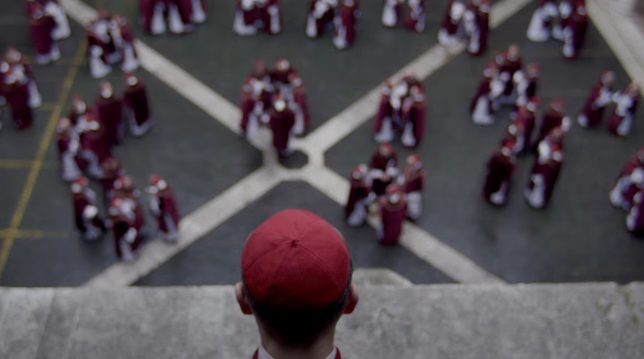
Beyond its deeper messages, Conclave thrives on subtle camp and drama, elevating it from a straightforward political thriller to an engaging cinematic experience. The Vatican setting—with its ornate architecture, flickering candlelight, and ceremonial grandeur—provides a visually arresting backdrop. Berger’s direction captures the absurdity and gravitas of the conclave process in equal measure, from the thunderous clang of sealed doors to the quiet intensity of whispered alliances. The film’s sly humour further enhances its appeal. Moments like the exaggerated thud of the Pope’s body being wheeled out or the surreal sight of cardinals scrolling through mobile phones provide a knowing wink to the audience, acknowledging the inherent contradictions of a modern Church steeped in tradition. These touches of levity balance the film’s heavier themes, making it accessible without diminishing its weight.
Stellar performances anchor the drama. Ralph Fiennes’ portrayal of Cardinal Lawrence is a masterclass in restraint, his internal conflict simmering beneath a composed exterior. Stanley Tucci’s Bellini exudes charm and quiet determination, while Lucian Msamati’s Adeyemi and John Lithgow’s Tremblay bring depth to their roles as contenders with hidden agendas. Isabella Rossellini’s brief but impactful appearance as a senior nun adds a touch of gravitas and wit, leaving audiences wanting more.
“I Am as God Made Me”
As the conclave unfolds, Berger artfully builds suspense, dropping breadcrumbs that lead to the film’s audacious twist. Enter Cardinal Benitez (Carlos Diehz), a last-minute contender from Kabul whose mysterious rise becomes the fulcrum of the story. It is eventually revealed that Benitez is intersex—a person born with both male and female reproductive traits. The discovery, made during a medical examination, is initially treated as a secret that could dismantle his candidacy. But Benitez’s simple yet profound response, “I am as God made me,” becomes a defining moment, not just for his character but for the entire narrative.
Berger’s handling of this revelation is strikingly measured. Rather than sensationalizing Benitez’s identity, the film uses it to challenge the audience’s preconceived notions of faith, identity, and worthiness. Benitez’s calm acceptance of his condition contrasts sharply with the chaos around him, positioning him as a figure of quiet strength and integrity. His androgyny—a blending of masculine and feminine traits—becomes symbolic of the film’s larger themes of duality and harmony. By presenting Benitez as the chosen leader of the Catholic Church, Conclave suggests that progress and tradition are not mutually exclusive but can coexist in unexpected ways.
The director’s vision is clear: the twist is not merely a plot device but a thematic statement. In a world increasingly divided by rigid binaries—religious versus secular, conservative versus progressive—Benitez’s election becomes a powerful metaphor for unity. It is a call to embrace complexity and ambiguity, a reminder that true leadership often lies in the spaces between.
Hermaphroditism: A Rooted Yet Futuristic Vision
The term “hermaphrodite,” derived from the union of Hermes (the Greek god of boundaries and transitions) and Aphrodite (the goddess of love and beauty), is as ancient as it is evocative. In Greek mythology, Hermaphroditus, their child, embodied both masculine and feminine qualities, symbolizing a transcendence of binary limitations. By weaving this concept into the heart of Conclave, the film taps into a rich historical and cultural lineage while projecting a bold vision for the future.
The Catholic Church, as portrayed in the film, is an institution bound by its scriptures and traditions. Yet, the election of Benitez—an intersex individual—as Pope serves as a radical endorsement of androgyny as a path forward. It suggests a future where identity is not confined by rigid definitions but celebrated in its full spectrum. Benitez’s declaration, “I am as God made me,” echoes as a profound theological statement, challenging centuries of dogma and inviting the Church to reimagine its relationship with humanity. Androgyny, as a concept, has often been associated with creativity, balance, and transcendence. In Conclave, it becomes a symbol of evolution, a bridge between the old and the new. The film’s portrayal of Benitez is not without its controversies—some critics argue that the twist risks reducing his identity to a narrative device. However, the film’s ultimate message is one of acceptance and progress. It dares to envision a world where even the most entrenched institutions can find room for inclusivity and change.
Resting the Case: The Future is in Authencity
As the credits roll, Conclave leaves its audience with much to ponder. It is a film that thrives on contradictions—faith and doubt, tradition and progress, masculinity and femininity—and finds its power in embracing them. The election of an intersex Pope may be a work of fiction, but it raises profound questions about the future of leadership and the boundaries of identity. By positioning androgyny as the way forward, Conclave suggests that the future belongs to those who can navigate the complexities of the human condition with grace and authenticity. In the words of Benitez, “I am as God made me.” Perhaps, in this version Vatican, the Church has taken its first step toward a more decisive world embracing power in duality. And perhaps, in reality, the film is a positive nudge to do the same.