
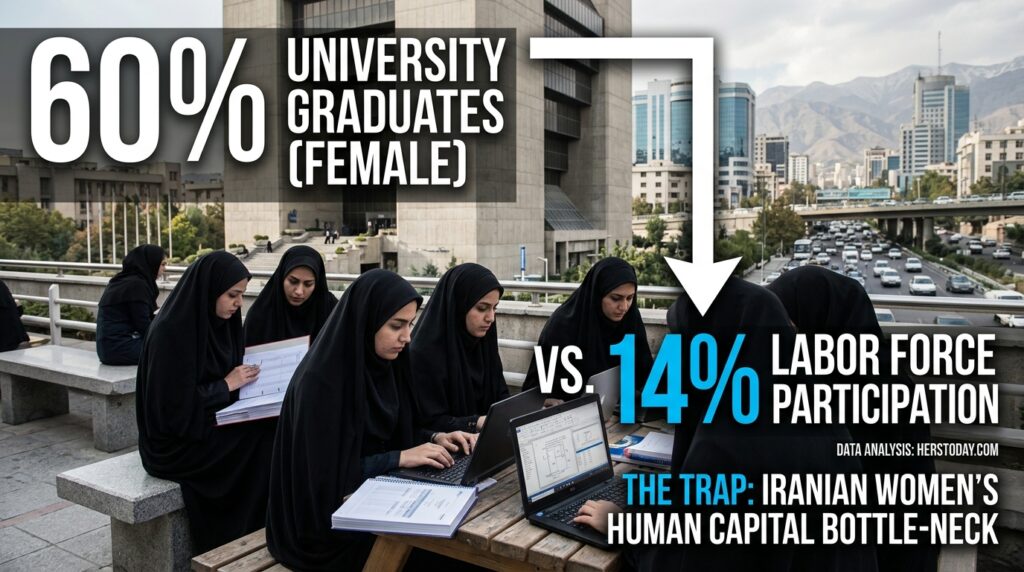
The narrative surrounding Iranian women is frequently framed in stark binaries of westernisation and oppression. Yet, computational analysis of demographic, educational, and economic data reveals a far more complex structural reality. Following the 1979 Revolution, Iran underwent a dramatic socio-demographic transformation. The state oversaw a historic expansion in female education and healthcare while simultaneously establishing a legal and economic architecture that systematically excluded women from formal employment. This dynamic has culminated in what data analysts term “The 14% Trap”: a structural bottleneck where one of the most hyper-educated female populations in the developing world remains restricted to a fractional presence in the formal labour market.
The Post-1979 Shift: The Data-Driven Pillars
To understand the mechanics of the current labour bottleneck, one must first examine the set of quantitative shifts that reshaped Iranian female demographics over the past several decades.
- The post-revolutionary era marked a complete semantic and structural re-anchoring of society. Where the pre-1979 Pahlavi monarchy pursued top-down secular modernization that primarily benefited an urban, cosmopolitan elite, the Islamic Republic mobilized traditional and rural demographics. State institutions expanded electricity, healthcare, and primary infrastructure into peripheral provinces, drawing millions of previously marginalized families into the national fold.
- This institutional expansion produced an unexpected educational leap known as the “Segregation Paradox”. Prior to the revolution, conservative and rural fathers frequently withheld their daughters from co-educational, secular schools. When the post-1979 government introduced mandatory veiling and gender-segregated classrooms, traditional families viewed the public school system as religiously safe. Consequently, UNESCO metrics show female literacy among young women (ages 15 to 24) surging from roughly 40% in 1976 to over 98% today, virtually eliminating the historical gender gap in basic education.
- This literacy boom created a university monopoly. By the early 2000s, female applicants routinely surpassed male applicants in national university entrance examinations (Konkoor). World Bank educational indicators reveal that women came to comprise between 55% and 60% of all tertiary education students in Iran. Furthermore, UNESCO data indicates that women account for approximately 35% to 40% of Iranian graduates in science, technology, engineering, and mathematics (STEM) fields – a ratio that rivals or exceeds many OECD economies.
- As women urbanized and spent longer years in formal education, Iran experienced one of the fastest demographic transitions in recorded history. Total Fertility Rates (TFR) plummeted from over 6.5 births per woman in the mid-1980s to approximately 1.68 births per woman today – well below the demographic replacement threshold of 2.1. Educated Iranian women executed a silent demographic strike, systematically delaying marriage and childbearing in response to urban living costs and changing life aspirations.
Ideological Dogma: The Motherhood Model
The structural conflict in modern Iran stems from the disconnect between this demographic reality and the state’s ideological doctrine regarding gender roles.
From its inception, the political canon established by Ayatollah Ruhollah Khomeini and maintained by Ayatollah Ali Khamenei defined the primary societal contribution of women through the framework of Afaf (purity), modesty, and maternal duty. State discourse positioned the pious mother as the primary line of defense against Western political and cultural encroachments.
The legal system was engineered around a traditional male-breadwinner framework. While the state actively encouraged female university attendance as a marker of Islamic development and technological self-reliance, it constructed institutional legal codes – such as Civil Code provisions requiring a husband’s formal permission for a woman to take certain jobs or travel abroad – that assumed women would prioritize domestic caregiving over long-term corporate or administrative careers.
The Labour Gap & The 14% Trap
This ideological design collides directly with economic data. According to compiled World Bank indicators, female labor force participation (FLFP) in Iran has remained stagnant at roughly 13% to 14% over the past two decades. By contrast, the global average for female labour force participation stands at over 51%, while male labour force participation in Iran exceeds 67%.
This disconnect between human capital development and economic integration forms the core of the paradox. On the supply side, demographic indicators demonstrate an exceptionally well-prepared female populace: youth literacy rates (ages 15–24) exceed 98%, women make up 55% to 60% of the total university student body, and female scholars account for roughly 35% to 40% of all STEM graduates. However, as these individuals attempt to transition into the workforce, they hit a severe structural bottleneck. On the demand side, formal economic absorption collapses to a female labour force participation rate of just roughly 14%, leaving unemployed higher-education graduates disproportionately female at approximately 70%.
Data analysis highlights three primary drivers maintaining this 14% trap:
Civil and Legal Restrictions: Statutory frameworks allow employers and husbands to exercise veto power over female mobility and employment conditions, discouraging corporate entities from placing women on executive management tracks.
Economic Sanctions and Male Preference: In an economy under sustained international sanction pressure and characterized by high youth unemployment, both public and private sector hiring managers systematically give preference to male applicants under the assumption that men carry the sole financial responsibility of household breadwinning.
Severe Educational Mismatch: Data from the Statistical Center of Iran shows that higher education degrees account for over 70% of total female unemployment, compared to less than 30% for men. The formal labour market fails to produce high-value knowledge-economy jobs capable of absorbing hyper-educated female talent.
Escape Valves: The Shadow Economy and Brain Drain
Because the formal domestic economy absorbs only a fraction of educated women, female human capital is diverted into two primary escape valves.
The first is the informal digital economy. Denied access to corporate management and state institutions, Iranian women have established a massive presence in unrecorded commerce. Using social media platforms, domestic online marketplaces, and global remote work networks, women operate micro-enterprises ranging from digital design and software translation to online retail and private tutoring. This invisible, shadow economy generates significant financial autonomy, though it remains entirely absent from official 14% GDP participation statistics.
The second valve is international human capital flight. Unable to reconcile their academic qualifications with domestic professional and personal restrictions, educated Iranian women represent a substantial portion of the nation’s ongoing brain drain. Emigration data shows consistent flows of female STEM graduates and medical professionals into university departments and tech sectors across North America and Western Europe.
An Unsustainable Demographic Trajectory
The data indicates that Iran’s current labour structure is economically unsustainable. Faced with an aging population, low fertility rates, and persistent macroeconomic strain, an economy cannot indefinitely sideline over half of its university-educated human capital. The 14% trap is not the result of a lack of female capability, but rather the structural friction generated when a hyper-educated populace encounters a regulatory and economic architecture that has failed to keep pace with demographic reality.
Data Sources & Analytical References
World Bank Open Data Group: Labor Force Participation Rate, Female (% of Female Population Ages 15+) – Islamic Republic of Iran (2020–2025 Series).
UNESCO Institute for Statistics (UIS): Education and Literacy Metrics: Adult and Youth Literacy Rates by Sex, Iran (1976–2023 Historical Data).
United Nations Population Division: World Population Prospects: Total Fertility Rate (TFR) Trajectory for the Islamic Republic of Iran (1980–2024).
Statistical Center of Iran (SCI): Annual National Population and Housing Census Data on Household Economics, Higher Education Enrolment, and Urbanization Rates.
UNESCO Science Report: Data Distributions on Global Female STEM Graduation Rates and Tertiary Educational Attainment.
Journal of Economic Studies: “Female Labor Participation in Iran: A Structural Model Estimation” (Peer-Reviewed Academic Paper, 2020).
The Iran Primer (United States Institute of Peace / Woodrow Wilson International Center): Women Face Bias in the Workplace (2017).
The Global Economy & World Bank Gender Data Portal: Iran Female Labor Force Participation Indicators (1990–2025 Historical Metrics).