Across different stages of life, questions of identity do not necessarily begin or end at a fixed point. For some, they emerge early, taking shape through observation, emulating, and uncertainty. For others, they may resurface later under different circumstances. At the 40th BFI Flare, Big Girls Don’t Cry and Montreal, My Beautiful both zoom in on this ongoing process, though different in setting and life stage. One follows a teenage girl at the early stages of self-discovery, navigating feelings she does not yet fully understand. The other focuses on a middle-aged woman who finds a sense of self-discovery outside the structure of an established life. Both protagonists have male figures in their respective lives; one creates confusion, the other containment. One struggles to understand desire, the other struggles to interpret it. Together, the two films beautifully present identity not as a resolved state, but as something that continues to evolve, and experienced.
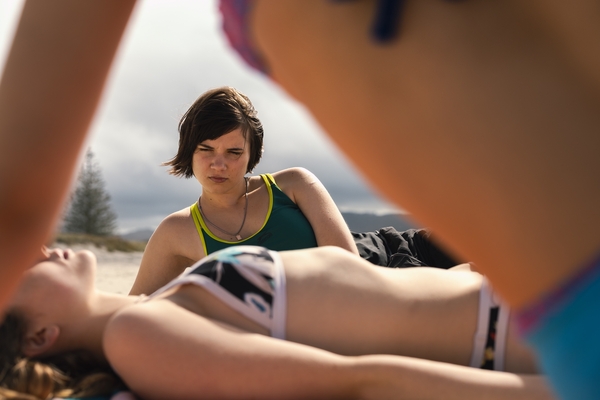
Big Girls Don’t Cry is a coming-of-age film that takes place over the course of a single summer in 2006, following Sid, a 14-year-old girl living in a small town in New Zealand. The film centres on her day-to-day experiences as she navigates friendships, family dynamics, and shifting social environments during a transitional stage of adolescence. Sid (a striking breakout performance by newcomer Ani Palmer) spends much of her time observing and interacting with a group of older teenagers, Lana (Beatrix Rain Wolfe), the popular girl in particular, whom Sid is somewhat infatuated with. Wanting to be included, Sid begins to adopt the behaviours she sees around her. Sid spends much of her time with her close friend Tia (Ngataitangirua Hita), though their dynamic changes due to Sid being part of the older group. She joins in drinking alcohol, smoking pot, and partying, gradually asserting herself into situations that feel unfamiliar but are perceived as necessary for social acceptance, including flirting with a trio of city boys. These moments are part of the social world she’s stepping into, and she moves through them cautiously, still figuring things out as she goes. Her attention is gradually drawn toward Freya (Rain Spencer), an American friend of her sister, Adele (Tara Canton). Their interactions are more low-key and comfortable, often playing out in secluded spaces or brief moments together, without anything being openly said about how Sid feels. Freya introduces a different kind of mixed social energy into Sid’s world. As the summer progresses, Sid navigates between different settings and gatherings, each bringing her different exposure to new experiences. Her interactions with her father Leo (Noah Taylor) – a struggling former artist now working as a mower, whose alcoholism at times leaves him emotionally absent – are marked by a mix of routine exchanges and moments of tension. Meanwhile, Tia’s older brother Diggy (Poroaki Merritt-McDonald) is an older boy who adds dynamic to Sid’s summer exploration. The cool kids group consists of Lana, Stevie (Sophia Kirkwood Smith), and the boys they met at the beach: Kyle (Ian Blackburn), Andy (Emile Boyle), and Willy (Caleb Cameron Lee). Things take a turn when Sid sees Freya in an intimate moment, which changes something in her. The film follows Sid through a series of small moments rather than culminating in one big event, with beach scenes, parties, and encounters building up over the summer as it plays out. Paloma Schneideman’s debut feature leans into a reflective, measured approach, creating a narrative through a sense of hindsight that brings a certain emotional clarity. Overall, Big Girls Don’t Cry is a slow-moving yet fascinating portrait of adolescence defined by observation and natural shifts in awareness. The film takes the audience through small interactions and changes in behaviour with a superbly natural performance by the leading cast, while the supporting cast reinforces its subtle tone. Schneideman refreshingly keeps the focus on lived experience rather than resolution, allowing moments to go by without emphasis. The film ends with Sid seizing the day, where her sense of self is starting to mature but is still largely unspoken.

At the other end of the spectrum, Montreal, My Beautiful follows a 53-year-old Chinese immigrant living in Montreal who’s beginning to experience resurfaced emotions. The film centres on her daily life, led by routine, family responsibilities, and the expectations that come with maintaining a household. Much of her time is spent between domestic spaces and a close-knit Chinese expat community environment, where her role within the family is clearly defined. Directed by Chinese-Canadian filmmaker Xiaodan He, Montreal, My Beautiful revolves around Feng Xia (Joan Chen), who has been living in Montreal for fourteen years with her husband Jun (John Xu), with whom she runs a small convenience store, while raising their two children, Joy (Pei Yao Xu) and Dong Dong (Anzhe Angelo Zhang). Her life is structured by typical family duty and expectations. Seeking to improve her French, Feng Xia enrols in a language class, where she meets Joseph (Zion-Luna Ribeaux Valdès), a young queer man from Cuba who has moved to Montreal for love. She begins to reflect on her past, including feelings connected to a childhood friendship that were never fully explored. After being introduced to online dating, she takes steps into unfamiliar territory and eventually meets Camille (Charlotte Aubin), a Québécoise woman. As her interactions with Camille become more intense, the balance between the two sides of her life becomes increasingly intricate. She continues her routines at home and at the shop, responsibly maintaining her roles as a wife and mother. Feng Xia and Camille’s interactions deepen as Camille’s openness and ease create a contrast to Feng Xia’s more reserved and routine-driven life. Over time, this develops into a more intimate dynamic, with moments of both emotional and physical connection. The film does not hinge on a single turning point, although there is a life-changing decision made by the family following the events. However, the film maintains its neutrality without forcing a clear resolution, allowing her story to remain open-ended.
The 40th BFI Flare: London LGBTQIA+ Film Festival takes place 18th–29th March at BFI Southbank.